Quick Guide — Best Facial for Combination Skin
Not sure which treatment suits your combination skin? Start here. As estheticians, we see combination skin every day, and the right facial can make a dramatic difference.
| Your Main Concern | Top Facial Recommendation | Why It Works |
| Oily T-zone with dry cheeks | Balanced zone facial | Treats each area with different products simultaneously. |
| Blackheads and congestion | Deep cleansing facial | Clears comedones from sebaceous glands without over-drying |
| Dehydrated dry zones | Hydrating facial with zone targeting | Delivers ceramides and hyaluronic acid to dry areas only |
| Uneven texture across the face | Enzyme exfoliation facial | Gently resurfaces without triggering sebum overproduction |
| Seasonal skin shifts | Customized seasonal facial | Adjusts treatment intensity based on current skin condition |
Pro Tip: Always inform your esthetician about your combination skin zones before treatment. A skilled professional will often use different products on your T-zone and cheeks during the same session.
Combination skin is one of the most common skin types — and one of the most mismanaged. When your T-zone is producing excess oil while your cheeks feel tight and dry at the same time, no single product applied uniformly across your face is going to solve both problems. The right facial for combination skin works differently — treating each zone as its own distinct biological environment within the same professional session. This guide covers exactly how that works, which treatments deliver the best results, and how to maintain your skin’s balance between appointments.
What Is Combination Skin? Understanding Unique Science
Combination skin is a skin type where different areas of the face behave in completely different ways at the same time. The T-zone, which includes the forehead, nose, and chin, tends to produce more oil due to a higher concentration and activity of sebaceous glands. In contrast, the cheeks and outer facial areas often produce less oil and struggle to retain moisture, making them more prone to dryness and sensitivity.
This imbalance is not random. It is driven by clear biological differences across facial zones, which is why treating the entire face with a single product often fails to deliver balanced results.
At a deeper level, combination skin is influenced by multiple factors:
- Higher sebum production in the T-zone due to increased sebaceous gland density
- Lower ceramide levels in the cheek area, leading to a weaker lipid barrier
- Increased transepidermal water loss (TEWL) in drier zones
- Differences in keratinocyte turnover that affect texture and smoothness
- Variations in skin microbiome activity between oily and dry regions
In simple terms, your T-zone behaves like an overactive oil-producing zone, while your cheeks function as moisture-deficient areas. This dual behavior is what makes combination skin unique and often difficult to manage with standard skincare routines.
Because of these structural and biological differences, combination skin requires a targeted approach where each zone is treated based on its individual needs rather than applying a uniform solution across the entire face.
Common Issues — T-Zone Oiliness and Dry Cheeks
Combination skin presents a specific and consistent pattern of concerns that licensed estheticians recognize immediately:
T-zones concerns:
- Enlarged pores from chronic sebum overproduction, stretching follicle walls.
- Persistent blackheads from follicular hyperkeratinization — dead keratinocytes mixing with excess sebum.
- Frequent breakouts driven by Propionibacterium acnes proliferating in sebum-filled follicles.
- Midday shine returns within hours of cleansing.
- Makeup oxidizes and breaks down in the central face.
Cheek concerns:
- Tightness and discomfort after cleansing — particularly in cold or dry weather.
- Visible fine lines appear more prominent due to inadequate moisture retention.
- Flaking or rough texture from disrupted desquamation of keratinocytes.
- Sensitivity and reactivity from a compromised lipid barrier.
- Dullness from poor light reflection on dehydrated skin surface.
Combination skin at a glance:
| Zone | Primary Issue | Biological Cause |
| Forehead | Oiliness, blackheads | High sebaceous gland density |
| Nose | Enlarges pores, congestion | Follicular hyperkeratinization |
| Chin | Breakouts, shine | Sebum overproduction |
| Cheeks | Dryness, sensitivity | Low ceramide levels, elevated TEWL |
| Around the eyes/mouth | Dehydration, fine lines | Minimal sebaceous gland presence |
For complete skin-type identification and treatment guidance, read our guide on facial treatment of skin type.
Best Facials for Combination Skin Options
Balanced Facial for Combination Skin Explained
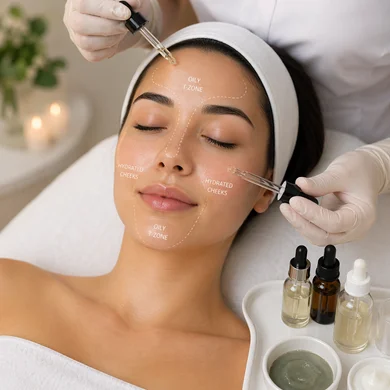
A professional balanced facial for combination skin uses a zone-based treatment approach — applying different products, different techniques, and different mask formulations to different areas of the face within a single session.
This is the fundamental difference between a professional combination skin facial and an at-home treatment. At home, most people apply the same product across the entire face, which either over-dries the cheeks when targeting T-zone oiliness or congests the T-zone when addressing cheek dryness. A skilled licensed esthetician treats each zone as its own distinct skin environment within the same appointment.
How a balanced facial works zone by zone:
T-zone protocol:
- Targeted steam application — softens follicular hyperkeratinization plugs for easier extraction.
- Professional extraction — removes comedones without rupturing follicle walls or triggering inflammatory cytokine response.
- Clay or salicylic acid mask — absorbs residual sebum overproduction, suppresses bacterial activity, and tightens pore appearance.
- Lightweight oil-free moisturizer finish — maintains pH balance without adding occlusive ingredients.
Cheek protocol:
- Gentle enzyme or lactic acid exfoliation — removes dead keratinocytes without disrupting the lipid barrier.
- Hydrating serum application — hyaluronic acid and ceramide-rich formulations reduce TEWL and restore moisture retention.
- Nourishing hydrating mask — replenishes the lipid barrier and supports collagen synthesis in fibroblasts.
- Rich emollient moisturizer finish — seals hydration without contributing to T-zone congestion.
Best for: All combination skin types — particularly effective for skin with a significant difference between T-zone oiliness and cheek dryness.
Deep Cleansing Facial for Combination Skin
The deep cleansing facial is one of the most effective professional treatments for combination skin — specifically for addressing the T-zone congestion that balanced facials may not target deeply enough on their own.
Combination skin’s T-zone accumulates comedones rapidly due to consistently elevated sebum overproduction from a higher density of sebaceous glands. Without regular professional deep cleansing, these comedones progress through follicular hyperkeratinization into inflammatory lesions — blackheads, whiteheads, and papules that a standard balanced facial cannot fully resolve.
How a deep cleansing facial addresses combination skin specifically:
A deep cleansing facial is adapted for combination skin by treating oily and dry zones separately within the same session. Instead of using one uniform method across the face, each step is customized to match the biological needs of the T-zone and cheeks.
Step 1 — Targeted steam on the T-zone only
Steam is applied only to the forehead, nose, and chin to soften comedone plugs for easier extraction. The cheeks are avoided to prevent damage to the lipid barrier and reduce transepidermal water loss (TEWL).
Step 2 — Professional T-zone extraction
Sterile comedone extractors remove blackheads, whiteheads, and sebum plugs from clogged follicles. This prevents follicular rupture, which can trigger an inflammatory cytokine response and scarring when done incorrectly.
Step 3 — Dual masking approach
- T-zone: Clay masks (kaolin or bentonite) absorb excess sebum and reduce bacterial activity
- Cheeks: Hydrating or ceramide masks restore moisture and repair the lipid barrier
Step 4 — Zone-specific finishing care
The T-zone is finished with a lightweight, oil-free moisturizer to maintain pH balance, while the cheeks receive richer emollients to rebuild ceramide levels and reduce TEWL.
Key benefits for combination skin:
- Thorough comedone removal from the T-zone without over-drying cheeks
- Suppression of Propionibacterium acnes activity in sebum-rich follicles
- Simultaneous hydration delivery to dry cheek zones
- Progressive reduction in T-zone pore size and congestion with consistent sessions
- Restored pH balance and skin microbiome equilibrium across both zones
Best for: Combination skin with significant T-zone congestion, persistent blackheads, frequent T-zone breakouts, or enlarged pores concentrated in the central face.
Frequency recommendation: Every 3 to 4 weeks for combination skin with active T-zone congestion — reducing to every 4 to 6 weeks during the maintenance phase when congestion is consistently controlled.
Targeted Treatments for Combination Skin
Beyond a full, balanced facial, several targeted professional treatments address specific combination-skin concerns with clinical precision.
Salicylic Acid Treatment for Oily T-zone
Salicylic acid — a beta-hydroxy acid (BHA) — is oil-soluble, meaning it penetrates through sebum into blocked follicles. Applied exclusively to the T-zone, it dissolves follicular hyperkeratinization plugs, regulates sebum overproduction from sebaceous glands, and suppresses Propionibacterium acnes bacterial activity — without ever contacting the drier cheek areas.
Hyaluronic Acid Treatment for Dry Cheeks
Applied exclusively to the cheek zones, a concentrated hyaluronic acid serum treatment delivers multi-molecular-weight hydration directly to the stratum corneum — drawing moisture toward dehydrated keratinocytes and plumping fine lines without any risk of T-zone congestion.
Enzyme Exfoliation for Combination Skin
Fruit enzyme exfoliation — using papain from papaya or bromelain from pineapple — gently digests dead keratinocytes across the entire face without the acid concentration that risks over-stimulating sebaceous glands in the T-zone or irritating the lipid barrier on the cheeks. This makes enzyme exfoliation one of the few full-face treatments genuinely safe and effective for combination skin.
LED Light Therapy for Combination Skin
Red LED light therapy at 630nm reduces inflammatory cytokines across the entire face — calming T-zone breakout activity while simultaneously supporting lipid barrier repair and collagen synthesis in fibroblasts in the cheek zones. One treatment — two simultaneous biological benefits.
For a complete overview of all facial treatment options, read our guide on types of facial treatments.
What Happens During a Facial for Combination Skin
Understanding the process helps you feel more confident before booking a session.
A typical treatment includes:
- Skin analysis to identify oily and dry zones
- Gentle cleansing suitable for all areas
- Targeted exfoliation based on skin needs
- Extraction focused on congested zones
- Dual masking for oil control and hydration
- Application of customized serums and moisturizers
Results You Can Expect
With the right treatment approach, combination skin becomes much easier to manage.
After consistent sessions, you may notice:
- Reduced oiliness in the T-zone
- Fewer blackheads and breakouts
- Softer, hydrated cheeks
- More even skin texture
- Healthy, natural glow
The key is consistency and choosing treatments designed specifically for your skin type.
Skincare Routine for Combination Skin
A correctly structured home routine is essential for extending the results of professional combination skin facials between sessions.
The key principle — use different products on different zones wherever possible.
Morning Routine for Combination Skin
Here’s how professionals typically structure a combination skin routine:
| Step | T-zone | Cheeks |
| Cleanser | Gentle foaming cleanser | Same – gentle foaming cleanser |
| Toner | BHA toner ( salicylic 0.5-1%) | Hydrating toner(hyaluronic acid) |
| Serum | Niacinamide – regulates sebum | Hyaluronic acid – reduces TEWL |
| Moisturizer | Lightweight oil-free gel | Rich ceramide cream |
| SPF | Broad-spectrum SPF 30+ | Same – broad-spectrum SPF 30+ |
Evening Routine for Combination Skin
| Step | T-zone | Cheeks |
| Cleanser | Double cleanse – micellar then foaming | Same |
| Treatment | BHA toner or low-dose retinol | Peptide or vitamin-rich cream |
| Moisturizer | Lightweight oil-free formula | Rich emollient with ceramides and squalane |
Key Ingredients for Combination Skin:
- Niacinamide — regulates sebaceous gland activity in the T-zone and strengthens the lipid barrier in the cheeks simultaneously
- Hyaluronic acid — multi-weight hydration that benefits all zones without adding oil
- Ceramides — targeted to cheek zones to reduce TEWL and restore barrier integrity
- Salicylic acid (0.5–1%) — T-zone only — maintains comedone-free follicles between professional sessions
- Squalane — lightweight skin-identical lipid that hydrates cheeks without occluding T-zone pores
Ingredients to avoid:
- Heavy mineral oils and thick butters contribute to follicular hyperkeratinization in the T-zone
- Alcohol-based toners applied across the full face — strip the lipid barrier from already-dry cheeks
- Aggressive physical exfoliants — disrupt both zones simultaneously
Seasonal Skincare for Combination Skin
Combination skin is more sensitive to seasonal change than almost any other skin type — because the T-zone and cheeks respond differently to humidity, temperature, and environmental conditions.
Seasonal Treatment Adjustments:
| Season | T-zone Behavior | Cheek Behavior | Facial Adjustment |
| Summer | Increased sebum production | May produce slightly more oil | Lighter hydration on cheeks, maintain T-zone deep cleansing |
| Winter | Moderate sebum — may decrease | Significantly drier, elevated TEWL | Richer cheek hydration, gentler T-zone treatment |
| Spring | Transitional — may flare | Transitional — may improve | Balanced approach — reassess with esthetician |
| Monsoon/Fall | Humidity increases congestion | May temporarily improve | Focus on T-zone clarification, maintain cheek barrier |
Practical Seasonal Tips:
- Reassess your home routine products every season — your T-zone and cheek needs change significantly between summer and winter.
- Inform your esthetician of any seasonal skin changes before each session — treatment adjustments should reflect the current skin condition.
- Book a professional facial at each seasonal transition — this is when combination skin is most likely to be imbalanced.
- Increase cheek moisturization in winter before dryness becomes visible — prevention is significantly more effective than correction.
How often should you get a facial for combination skin?
Every 4 weeks for most combination skin types. Seasonal transitions may require closer monitoring — book a professional facial at the beginning of each new season to reassess your skin’s current balance and adjust treatment accordingly.
Conclusion: Choosing the Right Facial for Combination Skin
Combination skin is not difficult to manage when treated correctly. The secret lies in understanding that your face has different needs in different areas. A well-designed facial for combination skin addresses oil production in the T-zone while restoring hydration in the cheeks, creating a balanced and healthy complexion.
The right facial for combination skin addresses the T-zone and cheeks as two distinct biological environments within the same session. A balanced facial uses zone-specific products and techniques to regulate sebum overproduction where it’s excessive and restore ceramide-based moisture where it’s deficient. Targeted treatments — salicylic acid for the T-zone, hyaluronic acid infusion for the cheeks, enzyme exfoliation for the full face — provide clinical precision that generic facials simply cannot match.
Key takeaways:
- Combination skin has fundamentally different biology in the T-zone versus the cheeks — treat them differently.
- A professional balanced facial uses zone-specific products and techniques within a single session.
- Niacinamide, hyaluronic acid, and ceramides are the three most universally beneficial ingredients for combination skin.
- Seasonal reassessment of your treatment plan keeps combination skin consistently balanced year-round.
- Commit to professional facials every 4 weeks — combination skin benefits from regular monitoring by a skilled esthetician.
Ready to explore all your professional treatment options? Browse our complete expert skincare guides at Best Facial Treatment – or read our ultimate guide to the best facial treatments for a full breakdown of every professional treatment available for your skin type.
FAQs
Can one facial product work for both oily and dry zones?
Yes, ingredients like niacinamide and hyaluronic acid can benefit both zones without causing imbalance.
Why does my T-zone get oily but my cheeks stay dry?
This happens due to higher oil gland activity in the center of the face and lower moisture retention in the cheeks.
Should I use different moisturizers on different parts of my face?
Yes, using a lightweight formula on oily area and a richer cream on dry areas gives better results.
Does combination skin change over time?
Yes, factors like age, weather, and hormones can shift your skin type gradually.
Why does combination skin become drier with age?
With age, oil production and skin hydration both decrease. Sebaceous glands become less active, and the skin loses natural lipids, leading to reduced moisture retention. As a result, previously oily areas like the T-zone gradually become drier and more balanced.
Is combination skin more difficult to treat than other skin types?
Combination skin is not more difficult to treat when managed with customized, zone-based treatments by a skilled esthetician.
What seasonal change affects combination skin the most?
Winter affects combination skin the most, causing drier cheeks and oily T-zone due to low humidity and increased TEWL.