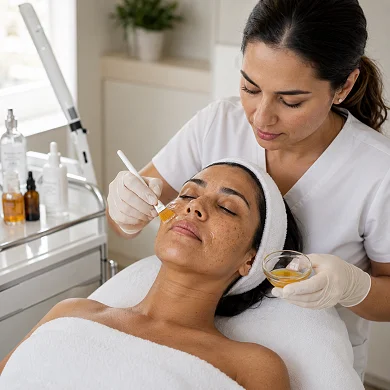
You fade a dark spot — and three new ones appear. You finally clear a breakout — and it leaves a mark that stays for months. You invest in treatments that work temporarily, then watch the patches return the moment you skip sunscreen for a week.
If this sounds familiar, you’re experiencing pigmentation exactly as your biology designed it — as a persistent, recurring response to triggers that most skincare routines never fully address.
This guide explains not just what to use, but why pigmentation behaves the way it does and how to target it at the melanocyte level, where it actually starts.
What is Pigmentation?
Pigmentation is one of the most stubborn skin concerns to treat — because it originates deep within the epidermis at the melanocyte level, not just on the surface. Dark spots, uneven tone, and melasma don’t disappear with standard cleansing or basic skincare — they require targeted professional treatments that work at the biological source of excess melanin production.
The right facial for pigmentation addresses every stage of the process — inhibiting new melanin formation, accelerating the shedding of already-pigmented keratinocytes, and protecting the newly revealed skin from the UV triggers that restart the cycle. This guide covers exactly how each treatment works and what you need to do to make your results last.
Best Facial for Pigmentation
The best facial for pigmentation is a professional brightening facial or chemical peel facial — because they directly target melanin overproduction in melanocytes, accelerate desquamation of pigmented keratinocytes, and inhibit the tyrosinase enzyme responsible for dark spot formation.
- Best overall: Brightening facial with AHAs and melanin inhibitors
- Fastest results: Chemical peel facial
- Best for sensitive pigmented skin: Vitamin C facial
Pigmentation responds best to consistent professional treatment combined with daily SPF — without sun protection, even the best facial cannot produce lasting results.
How to Identify Your Pigmentation Type and What Causes It
Understanding your pigmentation type is the first step toward choosing the right treatment. Each type looks different on the skin and is triggered by a specific biological cause. Identifying both the appearance and the underlying cause helps ensure effective and safe results.
Sun Spots (UV-Induced Hyperpigmentation)
Sun spots appear as small, flat, well-defined dark patches on areas frequently exposed to sunlight, such as the face, hands, and shoulders. They tend to become darker and more noticeable over time and do not fade easily on their own.
Cause:
These spots develop when UV radiation activates melanocytes, increasing melanin production through the tyrosinase enzyme. Continuous sun exposure keeps this process active, making them one of the most persistent types of pigmentation.
Post-Inflammatory Hyperpigmentation (PIH)
PIH shows up as flat dark marks that remain after acne, injury, or skin irritation. These marks usually match the location and shape of the original inflammation and are more common in medium to darker skin tones.
Cause:
Inflammation triggers melanocytes to produce excess melanin as part of the skin’s healing response. This pigment then spreads to surrounding keratinocytes, creating visible dark spots after the skin has healed.
Melasma (Hormonal Pigmentation)
Melasma appears as larger, uneven patches with irregular borders, commonly on the cheeks, forehead, upper lip, or chin. It is usually symmetrical, affecting both sides of the face.
Cause:
Hormonal changes, particularly fluctuations in estrogen and progesterone, overstimulate melanocytes. UV exposure further worsens the condition, making melasma one of the most challenging pigmentation types to manage.
Age Spots
Age spots are flat, oval-shaped dark marks that develop over time, typically after the age of 40. They appear in areas with long-term sun exposure and tend to increase in number with age.
Cause:
They result from cumulative UV damage over the years, leading to chronic melanocyte overactivity and uneven melanin distribution in the skin.
Not Sure Which Type You Have?
If your pigmentation pattern is unclear, a professional skin assessment is the safest way to determine the exact type. This is especially important before choosing treatments like chemical peels, as different pigmentation types respond differently and require tailored approaches.
Pigmentation types at a glance:
| Type | Primary Trigger | Key Feature |
| Sun spots | UV radiation | Continue Tyrosinase upregulation |
| PIH | Skin inflammation | Reactive melanocyte overproduction |
| Melasma | Hormonal fluctuation | Symmetrical patches — cheeks, forehead |
| Age spots | Cumulative UV damage | Chronic melanocyte dysregulation |
How Seasons Affect Pigmentation Treatment
Summer: UV index is highest — melanocyte activity peaks. This is the most important season for strict SPF discipline. Avoid aggressive chemical peels during peak summer months as UV exposure immediately post-peel dramatically increases PIH risk.
Autumn/Winter: Lower UV index makes this the ideal season for more aggressive chemical peel treatments. Reduced UV exposure during the post-peel healing phase significantly lowers rebound pigmentation risk.
Spring: Gradual UV increase — begin building SPF habits before summer arrives. Ideal for beginning a brightening facial maintenance program.
Year-round: Vitamin C facials and brightening facials are appropriate year-round — their mechanisms do not require low UV conditions to be safe and effective.
How Facials Help Reduce Dark Spots
Professional pigmentation facials work through three simultaneous biological mechanisms that no at-home treatment can replicate at clinical concentration:
1. Tyrosinase Inhibition
- Ingredients, including kojic acid, alpha arbutin, Vitamin C, and niacinamide, inhibit the tyrosinase enzyme
- Directly suppresses new melanin production at the melanocyte level
- Prevents new dark spots from forming before they reach the surface
2. Accelerated Desquamation of Pigmented Keratinocytes
- AHAs and chemical peels accelerate desquamation significantly faster than untreated skin
- Melanin is stored within keratinocytes — removing pigmented cells faster produces measurable lightening
- Each treatment cycle removes a fresh layer of pigmented cells — the results compound progressively
3. Barrier Repair and Inflammation Control
- A strengthened lipid barrier reduces low-grade inflammation that continuously restimulates melanocytes
- Professional treatments repair ceramide composition and reduce inflammatory cytokine activity
- Creates a stable skin environment in which pigmentation treatment is most effective
All three mechanisms must work together — treating only the surface without addressing melanocyte activity produces temporary results that fade quickly.
Best Facial Treatments for Pigmentation and Dark Spots
Brightening Facial
A professional brightening facial is the most comprehensively targeted dark spot treatment — addressing all three pigmentation mechanisms simultaneously.
What this treatment does:
- Applies professional-grade AHAs to dissolve bonds between pigmented keratinocytes and accelerate desquamation
- Delivers high-concentration kojic acid to inhibit tyrosinase enzyme activity at the melanocyte level
- Uses alpha arbutin — a gentle, stable tyrosinase inhibitor safe for all skin tones, including sensitive and darker complexions
- Applies niacinamide to reduce melanin transfer from melanocytes to surrounding keratinocytes
- Finishes with antioxidant-rich formulations and SPF to prevent UV-triggered tyrosinase reactivation
What you gain from this treatment:
- Inhibits tyrosinase enzyme — suppresses new dark spot formation at the source
- Accelerates desquamation — removes existing pigmented keratinocytes faster
- Reduces melanin transfer — prevents new pigmentation from reaching the surface
- Strengthens lipid barrier — reduces inflammation that restimulates melanocytes
- Produces progressive, compounding improvement with each consistent monthly session
Best for: All pigmentation types — particularly PIH, mild sun spots, and diffuse uneven skin tone.
Vitamin C Facial
A professional Vitamin C facial is one of the most scientifically validated treatments for skin pigmentation.
Its effectiveness comes from multiple simultaneous biological actions on melanin production and oxidative stress, not just a single mechanism.
What this treatment does:
- Delivers high-concentration L-ascorbic acid directly into the epidermis, at concentrations significantly exceeding at-home products.
- Inhibits tyrosinase enzyme through Vitamin C’s direct interaction with the enzyme’s copper-binding site, blocking tyrosine-to-melanin conversion at a molecular level.
- Neutralizes free radicals from UV exposure that trigger melanocyte overactivation.
- Stimulate collagen synthesis in fibroblasts, restoring structural luminosity alongside pigmentation reduction.
- Reduces existing hyperpigmentation by converting darker oxidized melanin forms to lighter ones.
Key biological actions of Vitamin C on pigmentation:
| Action | Biological Mechanism | Result |
| Tyrosinase inhibition | Blocks enzyme’s copper-binding site | Suppresses new melanin production |
| Free radical neutralization | Antioxidant electron donation | Prevents UV-triggered melanocyte activation |
| Melanin reduction | Converts oxidized melanin to lighter forms | Fades existing dark spots |
| Collagen synthesis stimulation | Fibroblasts signal activation | Restores skin luminosity and firmness |
| Lipid barrier support | Cermaide production enhancement | Reduces inflammatory melanocyte restimulation |
Best for: Sun-induced pigmentation, melasma maintenance, diffuse uneven tone, and all skin types, including sensitive skin.
Vitamin C facials work best when combined with daily at-home Vitamin C serum — professional treatment and home care maintain tyrosinase inhibition continuously.
Chemical Peel Facial
A chemical peel facial is the most intensive and fastest-acting professional treatment for pigmentation.
It produces the most dramatic visible improvement in dark spots of any facial available, because it removes pigmented keratinocytes in larger quantities per session than any other treatment.
How chemical peels work by depth:
Superficial Peels (AHAs — glycolic, lactic, mandelic acid)
Superficial peels are the safest and most accessible entry point for pigmentation treatment.
- Exfoliate the stratum corneum and upper epidermis
- Remove recently deposited pigmented keratinocytes
- Zero to minimal downtime — mild redness for 24 hours
- Safe for most skin types, including sensitive skin
Medium-Depth Peels (TCA — trichloroacetic acid)
Medium-depth peels go deeper, producing faster and more dramatic pigmentation improvement.
- Penetrates the mid-epidermis — removing deeper pigmented keratinocyte layers
- Stimulate significant collagen synthesis in fibroblasts through controlled wound healing
- 3 to 7 days downtime — peeling and redness expected
- Most effective for moderate sun spots, deeper PIH, and early melasma
Chemical peel comparison:
| Peel Type | Depth | Best For | Downtime | Skin Tone Safety |
| Superficial AHA | Stratum corneum | Mild PIH, surface pigmentation | None to mild | All skin tones |
| Mandelic acid | Upper epidermis | Darker skin tones, mild pigmentation | None to mild | All tones — safest |
| TCA medium | Mid-epidermis | Moderate sun spots, deeper PIH, and melasma | 3 to 7 days | Light to medium — assess first |
Important considerations for chemical peels and pigmentation:
- Fitzpatrick III–VI skin tones carry higher PIH risk from aggressive peels — always assess with a licensed esthetician first
- Mandelic acid is the safest AHA peel for darker complexions — larger molecular size means slower, more controlled penetration
- Pre-treatment priming with Vitamin C and kojic acid for 2 to 4 weeks before a peel significantly improves results
- Post-peel SPF is non-negotiable — freshly peeled stratum corneum is acutely vulnerable to UV-triggered melanin overproduction
Best for: Moderate to significant pigmentation — sun spots, deeper PIH, early melasma, and uneven skin tone that hasn’t responded adequately to brightening or Vitamin C facials.
How Long Does It Take to See Results?
Pigmentation treatment requires consistency, because skin renews itself every 28 days, and results appear gradually over time.
- After 1 session: slight improvement in brightness.
- After 3-4 sessions: visible fading of dark spots.
- After 6+ sessions: more even and balanced skin tone.
The key is regular treatments combined with proper daily care.
Common Mistakes That Worsen Pigmentation
Avoiding certain habits is just as important as treatment.
Common mistakes include:
- Skipping sunscreen, which allows UV to reactivate melanocytes.
- Over-exfoliating leads to irritation and more pigmentation.
- Picking acne causes post-inflammatory marks.
- Using harsh or alcohol based products
Simple, consistent care produces better results than aggressive treatments.
Which Treatment is Best for Your Pigmentation?
| Facial Type | Best Pigmentation type | Key Mechanism | Downtime | Skin Tone Suitability |
| Brightening Facial | PIH, mild sup spots, uneven tone | AHAs + tyrosinase inhibitors | None to mild | All skin tones |
| Vitamin C Facial | Sun damage, melasma maintenance, diffuse tone | Tyrosinase inhibition + free radical neutralization | None | All skin tones, including sensitive ones |
| Chemical Peel – superfacial | Mild PIH, surface pigmentation | Accelerated desquamation of pigmented keratinocytes | Mild – 24 hours | Most skin tones |
| Chemical Peel – medium | Moderate sun spots, deeper PIH, and melasma | Deep keratinocyte removal + collagen stimulation | 3 to 7 days | Light to medium tones — assess first |
Tips for Pigmentation Control
Sun Protection
Sun protection is not optional — it is the single most critical factor in whether professional pigmentation treatment produces lasting results.
UV radiation continuously reactivates melanocytes and upregulates tyrosinase enzyme activity. Without consistent SPF, every treatment’s results are progressively undone — regardless of how effective the facial was.
Evidence-based sun protection protocol:
- Apply broad-spectrum SPF 50 every morning — SPF 50 protects significantly better against the UVA wavelengths driving melanocyte activation than SPF 30
- Reapply every 2 hours during sun exposure — SPF degrades with UV, sweat, and skin contact
- Use mineral SPF (zinc oxide or titanium dioxide) — provides immediate broad-spectrum protection and is better tolerated by post-facial skin
- Wear physical protection — hats and UV-protective clothing provide coverage SPF alone cannot replicate
- Apply SPF as the final morning step — after moisturizer, before makeup
Without daily SPF 50, professional pigmentation treatment produces temporary results at best — UV reactivation of melanocytes undoes progress faster than treatment can deliver it.
Skincare Consistency
Pigmentation is a chronic biological condition requiring consistent management — not one-off treatment.
Why consistency matters:
- Melanocytes are continuously active — without regular tyrosinase inhibition, new pigmentation forms constantly
- Pigmented keratinocytes take 28 days to reach the surface — facials aligned with this cycle remove them before they compound existing spots
- PIH can redevelop rapidly if acne and inflammation are not consistently managed alongside pigmentation treatment
- Melasma is hormonally driven — it can only be managed consistently, never permanently eliminated
Morning routine:
- Gentle sulfate-free cleanser
- Niacinamide toner — reduces melanin transfer to keratinocytes
- Vitamin C serum (10–20%) — inhibits tyrosinase, neutralizes free radicals
- Lightweight ceramide moisturizer — repairs lipid barrier, reduces inflammation
- Broad-spectrum SPF 50 — prevents UV-triggered melanocyte reactivation
Evening routine:
- Micellar water — removes SPF and daily pollution
- Gentle foaming cleanser
- Alpha arbutin or kojic acid serum — continuous tyrosinase inhibition overnight
- Retinol serum (0.3–0.5%) — accelerates keratinocyte turnover, fades PIH
- Rich ceramide moisturizer — repairs lipid barrier during overnight renewal
Key Ingredients to Use
| Ingredient | Action | Benefit |
| Vitamin C | Tyrosinase inhibition + free radical neutralization | Fades existing spots, prevents new ones |
| Niacinamide | Reduces melanin transfer | Prevents pigmentation from reaching the surface |
| Alpa arbutin | Gentle tyrosinase inhibition | Safe for all skin tones |
| Kojic Acid | Potent tyrosinase inhibition | Targets persistent dark spots |
| Retinol | Accelerates keratinocyte turnover | Fades PIH overnight |
| AHAs | Chemical exfoliation | Removes pigmented surface cells |
| SPF 50 | UV protection | Prevents melanocyte reactivation daily |
Looking for product recommendations for pigmentation? See our expert-curated brightening skincare picks.
Ingredients to avoid for pigmentation-prone skin:
- Fragrance — triggers inflammatory cytokines that restimulate melanocyte activity
- Alcohol-based products — disrupt lipid barrier and increase inflammation
- Aggressive physical exfoliants — cause PIH through mechanical skin trauma
Conclusion
Pigmentation is a biologically complex condition — driven by tyrosinase enzyme activity, melanocyte overproduction, UV exposure, hormonal fluctuation, and chronic inflammation. The right facial for pigmentation addresses all of these mechanisms simultaneously — not just the visible dark spots on the surface.
Key takeaways:
- A brightening facial targets all pigmentation types through AHAs and tyrosinase inhibitors
- A Vitamin C facial provides the most comprehensive antioxidant and tyrosinase suppression available professionally
- A chemical peel facial delivers the fastest and most dramatic pigmentation improvement, with depth matched carefully to skin tone
- Daily SPF 50 is the single most important factor in making professional pigmentation treatment last
- Consistency — professional facials every 4 to 6 weeks, combined with a targeted home routine — is what produces genuine, lasting, even skin tone
Ready to address your pigmentation with the right professional treatment? Browse our complete expert guides at Best Facial Treatment — or read our ultimate guide to the best facial treatments to find the most effective treatment for your specific pigmentation concern today.
FAQs
Can a facial for pigmentation remove dark spots permanently?
No, facials help reduce and control pigmentation, but results are not permanent. Ongoing maintenance and daily sunscreen are essential to prevent recurrence.
How many sessions are needed to see results?
Most people notice improvement after 2-3 sessions, with more visible fading of pigmentation after 4-6 consistent treatments.
Is a chemical peel safe for pigmentation?
Yes, chemical peels are effective for pigmentation when performed by professionals. The type and strength should be chosen based on your skin type.
Which facial is best for sensitive skin with pigmentation?
A Vitamin C facial is ideal for sensitive skin as it gently reduces pigmentation while protecting the skin from further damage.
Does sunscreen really help with pigmentation?
Yes, sunscreen is essential. UV exposure is the main trigger for melanin production, and without SPF, pigmentation can return quickly.
Can acne scars cause pigmentation?
Yes, post-inflammatory hyperpigmentation (PIH) occurs after acne heals, leaving behind dark spots that can be treated with targeted facials.
How often should I get a facial for pigmentation?
It is recommended to get a facial every 4-6 weeks to align with the skin’s natural renewal cycle and maintain results.
Are home remedies effective for pigmentation?
Home remedies may provide mild improvement, but professional facials deliver faster and more noticeable results due to higher-strength active ingredients.
What ingredients help reduce pigmentation?
Effective ingredients include Vitamin C, niacinamide, alpha arbutin, kojic acid, retinol, and AHAs as they target melanin production and skin renewal.