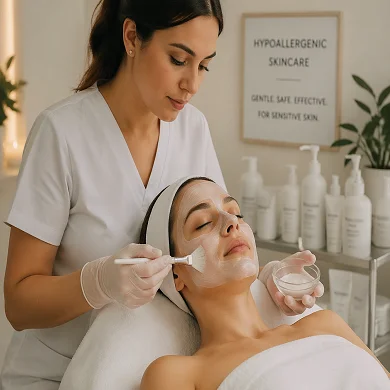
Sensitive skin doesn’t follow the same rules as other skin types — and treating it like it does is one of the most common mistakes in professional skincare. The traditional “no pain, no gain” philosophy in skincare is a dangerous myth when applied to delicate or reactive skin types. For sensitive skin, a standard facial is not always a routine treatment—it can feel unpredictable, with the risk of prolonged redness, irritation, or inflammation.
The wrong product, technique, or even temperature during a facial can easily trigger stinging, flushing, or an allergic response. However, what many people do not realize is that the right facial for sensitive skin is not only safe when properly designed, but can also be genuinely transformative in calming reactivity and strengthening the skin barrier.
It requires more careful selection, more thorough preparation, and a more knowledgeable esthetician. But the results are absolutely achievable.
Introduction to Facial for Sensitive Skin
Not sure which sensitive skin facial is right for you? Start here. This quick reference matches your primary skin concern to the most clinically appropriate professional treatment — before diving into the full guide below.
| Your Main Concern | Top Facial Recommendation | Why It Works |
| Redness/Flushing/Rosacea | Calming Facial or Cryotherapy Facial | Cools inflammation, no heat/steam |
| Dryness/Barrier Damage | Barrier Repair Facial | Replenishes ceramides without exfoliation |
| Allergies/Extreme Reactivity | Hypoallergenic Facial | Patch-, fragrance-free only |
| Post-Procedure or Flare Recovery | Oxygen Facial | Cooling oxygen infusion, zero contact |
| Add-On for Any | Red LED Light Therapy | Reduces cytokines, no blue light risk |
Pro Tip: Always request 48-hour patch testing and no steam/extractions.
Understanding Sensitive Skin Before Choosing a Facial for Sensitive Skin
Sensitive skin is characterized by an increased reactivity of the skin’s neurosensory system, meaning it responds more easily to stimuli that would not normally affect healthy skin. As a result, even mild triggers can lead to redness, burning, tightness, or discomfort.
This hyperactivity is rooted in two core biological factors:
Structural factor — compromised lipid barrier
- The stratum corneum is thinner and structurally deficient in sensitive skin
- The lipid barrier — composed of ceramides, cholesterol, and fatty acids — has reduced integrity
- Elevated transepidermal water loss (TEWL) occurs — moisture escapes faster than it’s replaced
- Irritants and allergens penetrate more deeply and rapidly, reaching immune cells and neurosensory receptors that trigger reactive responses
Immunological factor — overactive mast cells
- Mast cells in the dermis have a lower activation threshold in sensitive skin
- They release histamine and inflammatory cytokines in response to mild stimuli — fragrance, temperature changes, or light pressure
- This produces the characteristic redness, stinging, burning, and swelling of sensitive skin reactions
Sensitive skin can co-occur with:
- Rosacea — chronic vascular and immune dysregulation
- Contact dermatitis — allergic or irritant-triggered inflammation
- Seborrheic dermatitis — an inflammatory scalp and facial skin condition
Licensed estheticians identify sensitive skin through three consistent clinical markers:
| Marker | What It Looks Like |
| Subjective discomfort | Stringing or burning with product application |
| Objective signs | Persistent erythema, broken capillaries, and reactive flushing |
| Reaction history | Documented reactions to common skincare ingredients |
Common Triggers
Understanding what activates sensitive skin’s reactive response is essential before booking any professional facial. The most clinically documented triggers are:
Fragrance
- The single most common contact allergen in skincare
- Both synthetic fragrances and natural essential oils activate mast cells
- Triggers histamine release — producing stinging, redness, and contact dermatitis
Alcohol-based products
- Short-chain alcohols dissolve the lipid barrier’s ceramide structure rapidly
- Dramatically increase TEWL and strip the stratum corneum of natural protective compounds
- Leave sensitive skin acutely vulnerable to irritant penetration
High-concentration chemical exfoliants
- AHAs above 5% and BHAs above 2% increase cell turnover faster than sensitive skin tolerates
- Produce pronounced inflammatory cytokine activity and prolonged erythema
- Risk of permanent barrier damage in highly reactive skin
Mechanical exfoliation
- Microdermabrasion and coarse scrubs create micro-abrasions in the thin stratum corneum
- Provide direct entry points for irritants and bacteria
- Trigger mast cell degranulation through mechanical neurosensory receptor stimulation
Prolonged steam exposure
- Causes vasodilation of superficial blood vessels
- Particularly problematic for rosacea-prone skin, where vasodilation is already dysregulated
- Produces visible flushing and prolonged post-treatment erythema
Preservatives and emulsifiers
- Parabens, methylisothiazolinone, and certain emulsifiers are documented sensitizers
- Can trigger delayed contact dermatitis reactions appearing 24 to 48 hours after exposure
Recommended Facials for Sensitive Skin
Calming Facials
A professional calming facial is the most therapeutically appropriate treatment for reactive skin — designed to reduce inflammatory cytokine activity, soothe mast cell reactivity, and restore lipid barrier integrity without provoking immune responses.
Key botanicals used and their biological mechanisms:
| Botanical | Active Compounds | Skin Benefit |
| Centella asiatica (cica) | Asiaticoside, madecassoside | Suppresses inflammatory cytokines, stimulates collagen synthesis in fibroblasts, and repairs lipid barrier |
| Aloe vera | Acemannan polysaccharides | Inhibits histamine release from mast cells, supports skin microbiome balance |
| Green tea extract | EGCG antioxidants | Neutralizes free radicals, reduces inflammatory cytokine production, and strengthens the lipid barrier |
| Chamomile | Bisabolol, apigenin | Calms neurosensory receptor reactivity, reduces stinging and burning sensations |
Technique adjustments used in calming facials:
- Lighter massage pressure — reduces mechanical neurosensory receptor stimulation
- Cooler water temperatures — prevents vasodilation and vascular reactivity
- Minimal or no steam — avoids rosacea-triggering heat exposure
- No manual extraction unless absolutely necessary — eliminates mast cell degranulation risk from pressure
Best for: Reactive skin, rosacea-prone skin, post-procedure sensitivity, skin recovering from contact dermatitis flares.
Hypoallergenic Treatments
For skin with documented allergies or extreme reactivity, a professional hypoallergenic facial provides the highest formulation safety available in professional skincare.
Every product used is:
- Fragrance-free and dye-free
- Preservative-minimized
- Dermatologist-tested
- Selected specifically to minimize histamine-mediated allergic responses
Non-negotiable clinical protocols for hypoallergenic facials:
Pre-treatment patch testing
- Each product is applied to the inner forearm or behind the ear 48 hours before treatment
- Identifies both immediate and delayed hypersensitivity responses before full-face application
Simplified formulations
- Shortest possible ingredient lists
- Avoids complex multi-ingredient formulas that increase sensitization probability
pH-balanced formulations
- All products formulated within the skin’s natural pH balance range of 4.5 to 5.5
- Supports skin microbiome composition that moderates immune reactivity
Temperature-controlled application
- Products applied at or slightly below skin temperature
- Avoids thermal stimulation of neurosensory receptors in rosacea-prone skin
Best for: Skin with known contact allergies, confirmed fragrance sensitivity, diagnosed rosacea or contact dermatitis, or extreme multi-product reactivity.
Ingredients to Avoid
Knowing what to exclude is just as clinically important as knowing what to include. Here is a complete reference of high-risk ingredients for sensitive skin:
| Ingredient Category | Specific Examples | Risk Mechanism |
| Synthetic fragrance | Parfum, linalool, limonene | Mast cell activation, contact dermatitis |
| Essential oils | Lavender, peppermint, citrus oils | Neurosensory irritation, histamine release |
| Alcohol | SD alcohol, isopropyl alcohol | Lipid barrier stripping, TEWL increase |
| Strong preservatives | Methylisothiazolinone, formaldehyde releasers | Delayed contact sensitization |
| High-concentration AHAs | Glycolic acid >5%, lactic acid >5% | Inflammatory cytokine activation |
| Physical exfoliants | Walnut shell, sugar, salt scrubs | Stratum corneum micro-abrasion |
| Sulfates | Sodium lauryl sulfate (SLS) | Lipid barrier disruption, keratinocyte damage |
| High-concentration retinoids | Retinol >0.3%, tretinoin | Neurosensory receptor stimulation, barrier disruption |
Tips for Sensitive Skin Care
Patch Testing
Patch testing is the single most important pre-treatment protocol for sensitive skin — and one of the most frequently skipped steps in professional settings.
From an expert clinical standpoint, skipping patch testing on reactive skin is never acceptable. Not even with products marketed as gentle or hypoallergenic.
The correct 5-step patch testing protocol:
Step 1 — Apply test products: At least 48 hours before your facial, your esthetician applies a small amount of each product to the inner forearm or the back of the ear.
Step 2 — Leave sites undisturbed: Leave patch test sites uncovered and unwashed for 24 to 48 hours. Apply no other products to the test sites during this period.
Step 3 — Assess for two reaction types
| Reaction Type | Timing | Mechanism | Signs |
| Immediate hypersensitivity | Within 30 minutes | Histamine-mediated IgE response | Redness, swelling, itching |
| Delayed hypersensitivity | 24 to 48 hours | T-cell-mediated immune response | Redness, blistering, dermatitis |
Step 4 — Report any reaction immediately: Even a mild response indicates that the product must be excluded from the full facial entirely — no exceptions.
Step 5 — Proceed only when all sites are clear: All patch test sites must show zero reaction at the 48-hour assessment before treatment proceeds.
The Difference Between Sensitive and Sensitized Skin
It is a common misconception that sensitivity is always permanent. In many cases, skin is actually sensitized, meaning it is temporarily damaged due to environmental factors or overuse of harsh acids. A professional evaluation can determine if you need a permanent change in routine or a short-term barrier-recovery protocol to return your skin to its natural, resilient state.
Pre- and Post-Facial Care
Pre-facial care checklist for sensitive skin:
- Discontinue retinoids, high-concentration AHAs, BHAs, and vitamin C 72 hours before your facial.
- Avoid sun exposure, tanning, and heat treatments 48 hours before your appointment.
- Inform your esthetician about every product in your current routine.
- Disclose any known allergies, diagnosed skin conditions, and current medications.
- Arrive with a completely clean face — no makeup, SPF, or skincare products.
Post-facial care checklist for sensitive skin:
- Apply only esthetician-recommended products for the first 48 hours.
- Keep skin cool — avoid hot showers, saunas, steam rooms, and intense exercise for 24 to 48 hours.
- Apply mineral SPF 30 or higher from the morning after your facial — zinc oxide and titanium dioxide are significantly better tolerated than chemical UV filters.
- Avoid touching your face unnecessarily for 24 hours.
- Allow 72 hours for skin to fully settle before assessing results.
Professional vs At-Home Sensitive Skin Facial — Quick Comparison:
| Factor | Professional Facial | At-Home Facial |
| Formulation strength | Clinical-grade, professionally assessed | Consumer-grade, self-selected |
| Patch testing | Performed by a trained esthetician | Often skipped |
| Ingredient control | Full esthetician oversight | User-dependent |
| Technique | Controlled pressure and temperature | Uncontrolled |
| Reaction management | Immediate professional response available | No professional support |
| Results | Deeper, more lasting | Maintenance level only |
Conclusion
Sensitive skin deserves professional care — not avoidance of it.
The right facial for sensitive skin doesn’t aggravate reactivity — it actively reduces it. By addressing the underlying lipid barrier deficiency, calming mast cell hyperreactivity, supporting the skin microbiome, and using rigorously selected hypoallergenic formulations, professional calming and hypoallergenic facials produce genuine, lasting improvement in skin resilience and comfort.
Key takeaways:
- Always patch test — no exceptions for sensitive skin
- Always communicate your full skin history to your esthetician before treatment
- Avoid all high-risk ingredient categories documented in this guide
- Commit to a consistent schedule of gentle professional treatment every 4 to 6 weeks
- Sensitive skin doesn’t need less professional care — it needs better-chosen professional care
Ready to explore all your options? Browse our complete expert skincare guides at Best Facial Treatment — or read our complete guide on facial treatment for skin type to find exactly which professional treatments are right for your skin.
FAQs
How often should sensitive skin get a facial?
Sensitive skin benefits from a facial every 4 to 6 weeks. This timing allows the skin barrier to recover fully while maintaining hydration, calmness, and long-term skin health.
Are enzyme peels safe for sensitive skin?
Yes, enzyme peels are usually safe when used in low concentrations. Ingredients like papaya, pumpkin, or pineapple enzymes gently exfoliate without irritation. However, a patch test is recommended before treatment.
Why does my skin break out after a gentle facial?
Breakouts after a facial can be due to purging or a skin reaction. Purging happens when clogged pores surface, while reactions involve redness, itching, or irritation. If symptoms persist, consult a skincare professional.
Is microcurrent facial safe for sensitive skin?
Microcurrent facials are generally safe for sensitive skin. However, it's important to use a hypoallergenic conductive gel and avoid treatments during flare-ups or irritation.
What is the best facial for sensitive skin?
The best facial for sensitive skin is a calming and hydrating facial focused on barrier repair. Gentle ingredients like aloe vera, hyaluronic acid, and centella asiatica help reduce redness and strengthen the skin.
Can sensitive skin handle exfoliation?
Yes, but only gentle exfoliation is recommended. Mild enzyme exfoliants or low-strength acids work best, while harsh scrubs and strong chemical exfoliants should be avoided.
Are chemical peels safe for sensitive skin?
Mild chemical peels can be safe for sensitive skin when performed by professionals. Gentle acids like lactic acid or mandelic acid are usually preferred over stronger peels.
What type of facial ingredients should sensitive skin avoid?
Sensitive skin should avoid fragrance, alcohol, strong acids, and harsh scrubs. These ingredients may weaken the skin barrier and increase irritation.
What results can sensitive skin expect after a facial?
After a gentle facial, sensitive skin typically appears calmer, more hydrated, and less red. Results improve gradually with consistent treatments.