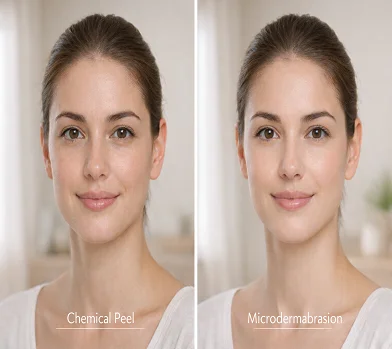
The healthy skin changes every time. Dead cells are shed, and new cells are formed under the surface. This natural process is slowed down by aging, exposure to the sun, pollution, and acne. Exfoliation regimes increase metabolism, leaving the skin underneath fresher.
Two well-known professional exfoliation methods are chemical peels and microdermabrasion. The two enhance the skin, although in different ways, in depth, and the problems that they solve.
What Is a Chemical Peel?
A chemical peel is a cosmetic procedure that involves the application of a specially designed solution to the skin to remove damaged skin layers that are damaged. The solution normally includes acids such as glycolic, salicylic, or lactic acids. These acids dissolve the complex that binds the dead cells of the skin.
The solution causes the outer layer of the skin to peel away as it is applied over the skin. New cells are formed as the old layer loses its cell mass, resulting in flattened, smoother skin.
The chemical peels can be classified into three levels in general:
Superficial peels
They act on the deepest layer of the skin and can be used in mild cases of discoloration, dullness, and tone irregularities.
Medium peels
They go deeper to treat moderate pigmentation, fine lines, and acne marks.
Deep peels
They go deeper into the skin, and they are usually applied to serious issues like deep wrinkles or ultraviolet damage.
Due to the stimulation of cellular renewal, chemical peels may commonly be used to treat pigmentation problems, uneven skin tone, or premature aging.
What Is Microdermabrasion?
Microdermabrasion is a mechanical exfoliation, non-invasive procedure that removes the uppermost dead dermis layer of the skin. Instead of chemicals, the process employs a device or sprays fine crystals or a diamond-tipped wand to polish the surface.
As the machine moves across the skin, it peels off the surface, and at the same time, a vacuum is used to remove the dead cells. This is done to enhance flow and help in the natural rejuvenation of the skin.
The following is normally the subject of microdermabrasion:
- Light dullness and roughness.
- Enlarged pores
- Minor pigmentation
- Early signs of sun damage
- Mild acne scarring
Microdermabrasion is said to be gentle, and there is a short time to recovery since it only acts on the deepest layer.
Significant Differences between Chemical Peels and Microdermabrasion
Although the two treatments are refreshing to the skin, they vary in their approach and degree.
Method of Exfoliation
Chemical peels involve controlled chemical reactions that break down dead skin cells and induce more renewal. Microdermabrasion scrubs the skin with a mechanical instrument.
Depth of Treatment
Deeper layers in chemical peels can be achieved depending on the type used, and that is why they are effective in high-profile concerns. The superficial layer is predominantly treated with microdermabrasion.
Skin Concerns Addressed
Chemical peels are the most effective in treating pigmentation problems, acne scars, and overt aging. Microdermabrasion is effective in softening texture issues and keeping the skin generally light.
Recovery Time
Superficial chemical peels can result in a few days of redness or peeling. More profound peels require more time. Microdermabrasion tends to be low in terms of downtime, and it produces redness that passes easily.
Which is the more Appropriate treatment?
Proper intervention should be based on the skin issues and sensitivity of an individual. For example:
- A chemical peel is usually more helpful to those with uneven pigmentation or deeper scars of acne.
- Microdermabrasion is favorable to people who want to have a softer texture and mild exfoliation.
The two treatments are widespread in skincare clinics as a part of more extensive maintenance plans. Dermatologists can determine skin type, sensitivity, and objectives and suggest which one to use instead of the other.
Educational materials, including such websites as Best Facial Treatment, where various skincare methods and contemporary treatments are discussed, can be found by those readers who may want to know more about professional facials and the mechanics of different procedures.
Final Thoughts
Chemical peels and microdermabrasion are excellent exfoliation therapies that are common in aesthetic dermatology as they contribute to skin renewal. The two are oriented to enhance clarity and texture, but their technique, depths, and target issues differ. Knowing these differences will make people understand how each treatment functions and why one professional might advise on one of them rather than the other. Both procedures are used in skincare science in general as instruments in favor of healthier, balanced skin. For more professional skincare insights, visit Best Facial Treatment.