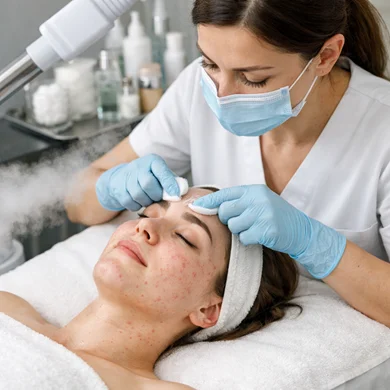
Acne is one of the most mismanaged skin conditions — not because effective treatments don’t exist, but because most people reach for the wrong ones. Harsh scrubs, over-cleansing, and aggressive at-home extraction often worsen the very problem they’re trying to solve. Understanding the best facial for acne is one of the most important steps toward genuinely clearer, healthier skin.
Professional acne facials work at a biological level — clearing comedones from sebaceous glands, suppressing Propionibacterium acnes bacteria, restoring the skin’s pH balance, and strengthening the lipid barrier. The right treatment, chosen correctly for your specific acne type, delivers results that no home routine alone can replicate. This blog covers exactly what you need to know — causes, treatments, and the precautions that make the difference between real results and setbacks.
Introduction to the Best Facial for Acne
Acne Causes and Types
Acne is a multifactorial skin condition driven by four interconnected biological processes — and understanding them is essential before choosing any acne facial treatment.
Sebum overproduction — the sebaceous glands produce excess sebum under hormonal influence, primarily androgens. This creates the ideal environment for follicular blockage and bacterial proliferation.
Follicular hyperkeratinization — dead keratinocytes fail to shed normally and accumulate inside hair follicles, mixing with excess sebum to form comedones — the clinical term for blackheads (open comedones) and whiteheads (closed comedones).
Propionibacterium acnes proliferation — this naturally occurring bacterium in the skin microbiome thrives in the oxygen-free environment of blocked follicles, producing inflammatory cytokines that trigger redness, swelling, and pain.
Chronic inflammation — the immune response to bacterial activity damages surrounding tissue, fibroblasts, and the lipid barrier — contributing to the post-acne hyperpigmentation and scarring that persist long after breakouts resolve.
Acne ranges from mild comedonal lesions to severe cystic nodules. Knowing your acne type determines which breakout treatment will deliver the most effective results for your specific condition.
Importance of Targeted Facials for Acne
Not every facial suits acne-prone skin — and the wrong treatment can make things significantly worse. An occlusive hydrating mask can trap bacteria in blocked follicles. Aggressive physical exfoliation on inflamed skin spreads Propionibacterium acnes across the surface and causes micro-tears that increase scarring risk.
Targeted acne-prone skin treatments address all four biological drivers simultaneously — clearing comedones, regulating sebum overproduction, suppressing bacterial activity, and calming the inflammatory cytokine response — without disrupting pH balance or compromising the lipid barrier. That’s the fundamental difference between a generic facial and a properly targeted acne treatment.
Recommended Acne Facials
Deep Cleansing Facial
The deep cleansing facial is the most widely recommended professional treatment for acne-prone skin — and its effectiveness lies in its systematic approach to clearing the follicular environment.
The steam application opens pores and softens follicular hyperkeratinization plugs, making extraction significantly easier and less traumatic. Professional extraction then removes blackheads, whiteheads, and comedones using sterile tools — clearing the entire sebum and keratinocyte plug from deep inside the follicle without rupturing the follicle wall.
This distinction matters. When follicle walls rupture — which happens with improper at-home squeezing — the contents release into the surrounding dermis, triggering a severe inflammatory cytokine response that leads to nodular lesions and potential scarring. Professional extraction eliminates this risk.
A purifying clay or charcoal mask completes the treatment — absorbing residual sebum from sebaceous glands and suppressing Propionibacterium acnes activity on the skin’s surface. Kaolin and bentonite clays have natural antimicrobial properties that actively reduce bacterial presence without disrupting the skin microbiome.
Best for: Mild to moderate comedonal and inflammatory acne — blackheads, whiteheads, papules, and superficial pustules.
Salicylic Acid Facial
A salicylic acid facial is the most scientifically targeted treatment for acne-prone skin — and its effectiveness comes down to one critical property: it is oil-soluble.
Unlike AHAs, which work on the skin’s surface, salicylic acid — a beta-hydroxy acid (BHA) — penetrates through the sebum filling blocked follicles and works inside the pore. It acts as a keratolytic, dissolving the bonds between dead keratinocytes that form comedone plugs from the inside out. Simultaneously, it exerts a direct anti-inflammatory effect — inhibiting the production of specific inflammatory cytokines that drive the redness and swelling of active breakouts.
Salicylic acid also has documented antimicrobial activity against Propionibacterium acnes — suppressing bacterial proliferation directly within the follicular environment. This triple action — comedolytic, anti-inflammatory, and antimicrobial — makes it one of the most comprehensively effective ingredients for acne treatment.
Professional concentrations of salicylic acid — typically 20% to 30% — produce exfoliation and comedolytic effects that significantly exceed what any over-the-counter product can deliver. Over a consistent series of treatments, sebum regulation improves, pore congestion decreases measurably, and post-acne hyperpigmentation fades due to accelerated keratinocyte turnover.
Best for: Oily acne-prone skin with comedones, papules, pustules, and post-acne hyperpigmentation. For skin-type-specific treatment guidance, read our complete guide on facial treatment for skin type.
HydraFacial for Acne
The HydraFacial combines everything acne-prone skin needs — exfoliation, extraction, and targeted serum infusion — in a single controlled session with zero downtime. Its patented vortex-fusion handpiece uses vacuum-assisted suction to simultaneously exfoliate, extract comedones, and infuse treatment actives without the manual pressure that risks follicle wall rupture.
For acne-prone skin, the HydraFacial protocol includes a glycolic and salicylic acid solution that loosens follicular hyperkeratinization plugs, followed by vortex extraction that clears sebum and cellular debris without trauma. Targeted serums — typically salicylic acid, niacinamide, and zinc — are then infused directly into the cleared follicles.
Niacinamide regulates sebum overproduction in sebaceous glands and calms inflammatory cytokine activity. Zinc has documented antimicrobial activity against Propionibacterium acnes and reduces the hormonal stimulation of sebaceous glands — addressing one of acne’s primary biological drivers. Many HydraFacial sessions also incorporate blue LED light therapy at 415nm — a wavelength with clinical efficacy in destroying Propionibacterium acnes at the follicular level without chemical application.
Best for: All acne types and severities, including sensitive acne-prone skin. Explore all professional options in our ultimate guide to the best facial treatments.
Tips & Precautions
Avoid Irritation
Managing acne-prone skin requires as much attention to what you avoid as what you do. Follow these precautions consistently:
Before your facial:
- Stop retinoids, high-concentration AHAs, BHAs, and benzoyl peroxide 48 to 72 hours before your appointment — these increase sensitivity and risk excessive irritation when combined with professional-strength treatments
- Do not manually pick or squeeze existing breakouts — this spreads Propionibacterium acnes bacteria and increases post-treatment infection risk
- Arrive with a completely clean face — no makeup, SPF, or skincare products
After your facial:
- Keep your hands away from your face — transferring bacteria to freshly treated skin triggers new breakouts
- Avoid heavy makeup for 24 hours — freshly extracted pores are temporarily more vulnerable to re-congestion
- Apply SPF 30 or higher every morning — exfoliating acne treatments increase UV sensitivity, and unprotected sun exposure worsens post-inflammatory hyperpigmentation
- Avoid hot showers and intense exercise for 24 hours — heat increases inflammatory cytokine activity
On purging: Some clients experience a mild purging phase after the first one or two professional acne facials. This occurs when treatment brings deep comedones to the surface more rapidly than they would appear naturally — it is a normal, temporary response that resolves within 1 to 2 weeks and is followed by noticeable improvement in skin clarity.
Frequency Recommendations
Consistency is the most critical factor in achieving lasting results from any acne facial treatment. Your skin operates on a 28-day renewal cycle — the time it takes for new keratinocytes to travel from the deepest epidermal layer to the surface. A professional facial aligned with this cycle ensures comedone buildup is systematically cleared before reaching the inflammatory stage.
Recommended frequency by acne type:
| Acne Type | Recommended Frequency |
| Mild comedonal acne | Every 4 to 6 weeks |
| Moderate inflammatory acne | Every 3 to 4 weeks initially |
| Severe nodular or cystic acne | Dermatologist consultation first |
| Post-acne maintenance | Every 4 to 6 weeks |
For severe or persistent cystic acne, always consult a dermatologist before booking professional facial treatments. Facials are a highly effective complement to medical acne management — not a substitute for it.
Conclusion
The best facial for acne is one that addresses acne’s biological root causes — not just its surface symptoms. A deep cleansing facial systematically clears comedones and purifies the follicular environment. A salicylic acid facial penetrates inside blocked pores — dissolving plugs and suppressing Propionibacterium acnes activity simultaneously. A HydraFacial combines exfoliation, extraction, and targeted serum infusion in a single controlled session, suitable for all acne types.
Choosing the right treatment is only half the equation. Consistency aligned with your skin’s 28-day renewal cycle, diligent pre and post-care, and daily SPF protection are what transform occasional clear days into genuinely lasting skin improvement. Work with a licensed esthetician who understands acne biology — and commit to a treatment plan rather than a one-off session.
Ready to take the next step toward clearer skin? Explore our complete expert guides at Best Facial Treatment — or read our types of facial treatments guide for a full breakdown of every professional option available.
FAQs
Can facials make acne worse?
Yes — if the wrong treatment is chosen. Occlusive masks trap bacteria in blocked follicles. Aggressive physical exfoliation spreads Propionibacterium acnes and causes micro-tears. Always choose an acne-specific treatment and inform your esthetician about your skin condition.
How often should I get a facial for acne?
Every 3 to 4 weeks for moderate inflammatory acne initially — reducing to every 4 to 6 weeks for maintenance. Consistency aligned with the skin's 28-day renewal cycle produces the most significant long-term reduction in breakout frequency.
Is a HydraFacial good for acne-prone skin?
Yes — a HydraFacial is one of the most effective and gentle options for acne-prone skin. Its vortex extraction clears comedones without manual pressure while salicylic acid and niacinamide serums target sebum overproduction and bacterial activity simultaneously.
What should I avoid after an acne facial?
Avoid touching your face, wearing heavy makeup, reintroducing strong actives, hot showers, and sun exposure without SPF for 24 to 48 hours. These compromise the lipid barrier and increase post-treatment breakout and hyperpigmentation risk.
Can I get a facial with cystic acne?
Consult a dermatologist first. Cystic acne involves deep dermal inflammation that often requires medical management before professional facials can be safely performed. Facials complement medical acne treatment effectively — but should never replace it.