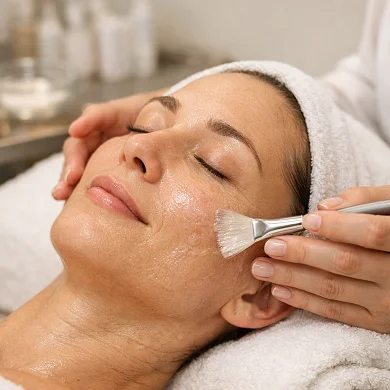
Dry skin is more than a cosmetic inconvenience — it’s a biological signal that your skin’s protective barrier is struggling to retain the moisture it needs to function properly.
No matter how much moisturizer you apply, if the underlying barrier is compromised, hydration escapes faster than it can be replaced.
That’s why the right facial for dry skin isn’t just about adding moisture temporarily — it’s about repairing the skin at a structural level so it can hold onto hydration long after you leave the treatment room.
Professional hydrating facials use clinical-grade ingredients and evidence-based techniques that go significantly deeper than any home routine. These treatments:
- Rebuild the lipid barrier
- Restore the natural moisturizing factor
- Deliver concentrated humectants
- Improve long-term hydration retention
This guide covers:
- Biological signs of dry skin
- Why professional facial for dry skin treatments matter
- The best facial for dry skin options
- Home care practices that extend results
Introduction to Facial for Dry Skin
Dry skin requires more than basic moisturization — it needs targeted dry skin facial treatment that restores hydration and strengthens the skin’s protective barrier.
A professional facial for dry skin is designed to deeply nourish, repair, and replenish moisture levels using specialized techniques and clinical-grade ingredients.
Unlike at-home skincare routines that work mainly on the surface, hydrating facial treatments deliver moisture to multiple layers of the skin while:
- Improving texture
- Reducing flakiness
- Enhancing comfort
- Supporting long-term hydration
Regular treatments provide immediate relief while helping maintain long-term skin health, leaving the complexion:
- Smoother
- More resilient
- Naturally radiant
Who Should Get a Facial for Dry Skin
You may benefit from a facial for dry skin if you experience:
- Persistent tightness after cleansing
- Flaky or rough skin texture
- Dull or tired-looking complexion
- Increased sensitivity or redness
- Fine lines appear more prominent
- Makeup sitting unevenly on the skin
Professional hydrating facials are especially beneficial during:
- Winter months
- Air-conditioned environments
- After travel or dehydration
- Aging-related dryness
These treatments help restore moisture levels and improve overall skin comfort.
Signs of Dry Skin
Dry skin is clinically characterized by reduced water retention in the stratum corneum — the outermost layer of the epidermis — combined with a deficiency in lipid compounds that form the skin’s protective barrier.
Dermatologists and licensed estheticians identify dry skin through the following indicators:
Tightness and Discomfort
The most immediate sign of dry skin is persistent tightness, especially after cleansing.
This occurs because water loss leaves keratinocytes dehydrated and contracted, reducing flexibility and suppleness.
Visible Flaking and Rough Texture
When desquamation is disrupted by insufficient moisture:
- Dead cells accumulate
- Skin appears rough
- Flaking becomes visible
- Texture becomes dull
Increased Transepidermal Water Loss (TEWL)
Transepidermal water loss (TEWL) measures moisture evaporating from the skin.
When the lipid barrier is compromised:
- Moisture escapes faster
- Hydration becomes difficult to maintain
- Skin becomes chronically dry
Pronounced Fine Lines and Premature Aging
Dehydrated keratinocytes lose volume, causing:
- Fine lines
- Surface wrinkles
- Dullness
Chronic dryness also accelerates collagen breakdown.
Sensitivity and Reactivity
A compromised barrier allows:
- Irritants
- Allergens
- Pollution
This increases skin sensitivity and inflammation.
Causes of Dry Skin
Dry skin can result from several factors:
- Cold weather and low humidity
- Hot showers and harsh cleansers
- Aging and reduced sebum production
- Over-exfoliation
- Dehydration
- Environmental pollution
- Medical conditions such as eczema
Understanding the cause helps determine the best facial for dry skin.
Why Hydration is Critical for Dry Skin
Inadequate hydration doesn’t just affect appearance — it compromises skin function at every level.
Natural Moisturizing Factor (NMF)
The natural moisturizing factor (NMF) helps skin retain water.
When NMF levels decrease:
- Skin becomes rigid
- Cracking increases
- Barrier damage worsens
Role of Aquaporins
Aquaporins regulate water movement between cells.
When hydration is low:
- Water distribution becomes inefficient
- Skin dryness increases
Importance of Professional Hydrating Facial Treatments
Regular professional facial for dry skin treatments:
- Repair barrier damage
- Restore hydration
- Reduce TEWL
- Improve skin resilience
Licensed estheticians identify barrier repair as the foundation of any effective dry skin treatment plan.
For a complete overview of skin-type-specific treatments, read our guide on facial treatment for skin type.
What Happens During a Facial for Dry Skin
A professional facial for dry skin typically includes:
- Gentle cleansing
- Mild exfoliation
- Hydrating serum application
- Facial massage to improve circulation
- Nutrient-rich mask
- Moisturizer and SPF application
Each step is designed to restore hydration and repair the skin barrier.
Recommended Facials for Dry Skin
| Facial Type | Best For | Key Benefits |
| Hydrating Facial | Mid to moderate dryness | Deep hydration |
| Nutrient-Rich Facial | Aging dry skin | Barrier repair |
| Moisturizing Mask | Severe dryness | Intensive nourishment |
| HydraFacial | All dry skin types | Immediate results |
Hydrating Facials
A hydrating facial is the most effective facial for dry skin.
It delivers layered hydration using:
- Humectants
- Emollients
- Occlusives
Key Ingredients
Hyaluronic Acid
- Holds up to 1000x its weight in water
- Plumps dehydrated cells
- Improves elasticity
Glycerin
- Supports NMF
- Improves hydration retention
HydraFacial
The HydraFacial combines:
- Gentle exfoliation
- Extraction
- Serum infusion
Best for: All dry skin types.
Nutrient-Rich Treatments
These dry skin facial treatments provide:
- Vitamins
- Fatty acids
- Antioxidants
- Peptides
Key Ingredients
- Vitamin E
- Rosehip Oil
- Squalane
- Peptides
Best for: Dry skin with aging signs.
Moisturizing Masks
Professional masks deliver intensive hydration through occlusion.
Key Ingredients
- Ceramides
- Colloidal oats
Best for: Severe dryness.
Tips to Maintain Hydration
Skincare Routine
Professional hydrating facials deliver significant results — but what you apply at home between sessions determines how long those results last. A correctly structured home routine for dry skin focuses on three priorities: hydrating, sealing, and protecting.
Morning routine for dry skin:
- Gentle cream or milk cleanser — preserves lipid barrier integrity while removing overnight buildup
- Hyaluronic acid serum — applied to damp skin to maximize water-binding effectiveness
- Ceramide-rich moisturizer — replenishes the lipid barrier and reduces TEWL throughout the day
- Broad-spectrum SPF 30 or higher — UV radiation degrades ceramides and accelerates lipid barrier breakdown in dry skin
Evening routine for dry skin:
- Cream cleanser — never foaming or sulfate-based formulations, which strip the lipid barrier
- Vitamin C or peptide serum — supports collagen synthesis in fibroblasts and addresses the fine lines that dry skin makes more prominent
- Rich moisturizer containing ceramides, squalane, and emollients — applied generously to seal overnight hydration
- Occasional facial oil as the final step — rosehip or marula oil locks in moisture through occlusion without blocking pores
Ingredients to prioritize: Ceramides, hyaluronic acid, glycerin, squalane, natural moisturizing factor components (urea, lactic acid, amino acids), niacinamide, and peptides.
Ingredients to avoid: Alcohol-based toners, sulfate cleansers, fragrance, and high-concentration AHAs used without adequate moisturization — all of which increase TEWL and accelerate lipid barrier degradation in dry skin.
Home Care
Lifestyle habits play a major role in maintaining the results of a professional facial for dry skin. Small changes can significantly improve hydration and support long-term skin health.
Using a humidifier, especially in air-conditioned or heated environments, helps reduce moisture loss and supports overnight repair. Applying moisturizer within 60 seconds of cleansing also helps lock in hydration before it evaporates.
Avoid hot showers, as high temperatures strip the skin’s natural oils and increase dryness. Instead, use lukewarm water and follow with moisturizer immediately.
Staying properly hydrated supports skin function from within, while regular dry skin facial treatment sessions every 3 to 4 weeks help maintain consistent hydration and barrier strength.
How Long Do Facial Results Last?
Results from a hydrating facial typically last 2 to 4 weeks, depending on:
- Skin type
- Climate
- Home skincare routine
- Hydration levels
Regular treatments help maintain consistent hydration.
Conclusion
Dry skin isn’t just a surface problem — it’s a barrier problem. And the right facial for dry skin addresses it at exactly that level — repairing and reinforcing the lipid barrier, restoring the natural moisturizing factor, reducing transepidermal water loss, and delivering concentrated hydration to the stratum corneum in ways that no home routine alone can replicate.
A professional hydrating facial delivers layered moisture through clinical-grade humectants and occlusives. A nutrient-rich treatment feeds the fibroblasts and keratinocytes responsible for the skin’s structural hydration capacity. A professional moisturizing mask seals everything in — using ceramide-based and occlusive formulations that repair the barrier’s fundamental architecture.
Pair your professional treatment with a correctly structured home routine — gentle cleansing, consistent ceramide moisturization, and daily SPF — and commit to professional sessions every 3 to 4 weeks. That combination is what transforms chronically dry, uncomfortable skin into a genuinely well-hydrated, resilient, and healthy complexion.
Ready to explore all your professional treatment options? Browse our complete expert skincare guides at Best Facial Treatment — or read our ultimate guide to the best facial treatments for a comprehensive overview of every professional treatment available for your skin type.
FAQs
How often should I get a facial for dry skin?
Every 3 to 4 weeks to maintain hydration and support the skin's natural renewal cycle.
What ingredients should I look for in a facial for dry skin?
Hyaluronic acid, ceramides, glycerin, squalane, peptides, and Vitamin E help restore hydration and repair the skin barrier.
Can a facial make dry skin worse?
Yes. Harsh exfoliating facials or strong acids can damage the skin barrier and increase dryness.
Is the HydraFacial good for dry skin?
Yes. HydraFacial gently exfoliates and infuses hydrating serums, making it effective for dry skin.
What is the difference between dry skin and dehydrated skin?
Dry skin lacks oil. Dehydrated skin lacks water. Both benefit from hydrating facials.
Can a facial help extremely dry skin?
Yes, a professional facial for dry skin can significantly improve severe dryness by delivering concentrated hydration and repairing the lipid barrier.
Can I do a Facial for dry skin at home?
At-home facials can help temporarily, but professional facial for dry skin treatments provide deep hydration and longer-lasting results.
Should I exfoliate dry skin before a facial?
Gentle exfoliation helps improve product absorption, but excessive exfoliation can worsen dryness. Professional guidance is recommended.
Do facials help dry skin in winter?
Yes, winter conditions increase dryness. Regular hydration facial treatments help maintain moisture and prevent seasonal dryness.
What are the benefits of hydrating facials?
Hydrating facial benefits include:
- Deep hydration
- Barrier repair
- Improved skin texture
- Reduced falkiness
- Bright complexion
Can men get facials for dry skin?
Yes, dry skin facial treatment is beneficial for all skin types, regardless of gender.
When will I see the results from a facial for dry skin?
Most people notice immediate improvement after a professional facial for dry skin, with continued improvement over the following days.